Signals/ Claude & Anthropic/ Reel /
An Open AI Model Just Came Within 1 Point of Claude Opus
Moonshot's Kimi K3.1 Pro is an open-weight model with a 1-million-token memory that scored 65.7% on a top coding benchmark, a point behind Claude Opus 5.5. What launched, the numbers, the catch, and a fair way to test it on your own work.
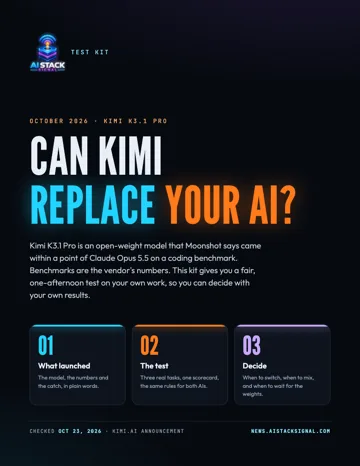
Free test kit · 7 pages · PDF
Can Kimi replace your AI?
Three real tasks, the same prompt for both AIs, a one-page scorecard, a blind-judging prompt, and when to switch, mix or wait for the open weights.
⬇ Download the PDFAn open-weight AI model just came within one point of Claude Opus 5.5 on a well-known coding benchmark, according to the company that made it. Moonshot’s Kimi K3.1 Pro is out now, and the company says the full model weights will be downloadable by November 4.

What launched
Kimi K3.1 Pro is the first model in Moonshot’s K3.1 series. Moonshot calls it a “3T-class open-weight model” with a 1-million-token context window, meaning it can read a very large amount of text or code at once.
It’s available now in Kimi.ai, the Kimi mobile apps, Kimi Work, Kimi Code and the Kimi API (model ID kimi-k3.1-pro). For companies on Kimi Enterprise, an administrator has to turn it on first.

The photo finish
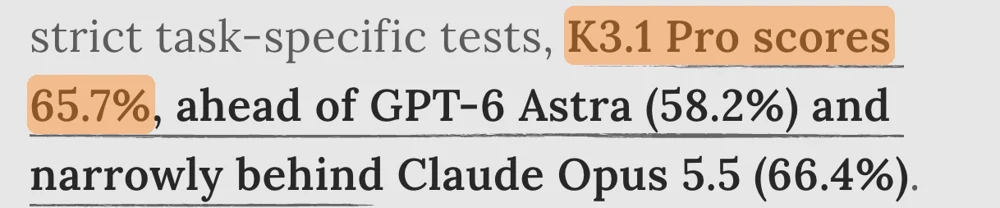
Terminal-Bench 4.0 tests coding agents on realistic terminal tasks with strict pass/fail checks. Moonshot reports:
- Kimi K3.1 Pro: 65.7%
- Claude Opus 5.5: 66.4%
- GPT-6 Astra: 58.2%
Moonshot also reports 61.2% on its own internal Kimi Code Bench 3.0 Long-horizon, up from 55.95% for the previous K3 model, and strong results on office and finance tasks.
Faster, and fewer made-up claims

There’s a second version, K3.1 Pro Highspeed (kimi-k3.1-pro-highspeed), which Moonshot says runs 2–3× faster than the standard model.

Moonshot also worked on accuracy. On its hardest internal stress test for made-up facts, run with tools, the share of false claims fell from 23.4% for K3 to 8.3% for K3.1 Pro. Moonshot notes the test is built to provoke mistakes, so those rates “do not represent overall error rates in daily use.”
The catch
- These are Moonshot’s own numbers. Several come from its internal benchmarks, and some competitor scores came from other leaderboards or reports.
- It doesn’t win everywhere. On BenchCAD (with tools) it scored 92.7, behind Claude Opus 5.5 (96.2) and GPT-6 Astra (95.9).
- The weights aren’t out yet. Moonshot says the full weights will be released by November 4, 2026, so running it on your own hardware has to wait.
- Cyber skills were deliberately reduced. Moonshot removed cyber-related training data and says the model is behind the top closed models there.

How to test it fairly
A benchmark tells you how a model does on someone else’s tasks. Before you switch, run it against the AI you use today on your own work.
Workflow
- Pick three tasks you do every week: a coding or build task, a long-document question, and something fact-heavy where a wrong number would hurt.
- Give both AIs the exact same prompt, files and time limit. Don’t help either one.
- Score each answer: did it finish, was it correct, did it make anything up, how long did it take, what did it cost, and how much did you have to fix.
- Switch if it ties or wins on two of three. Mix if it only wins one kind of task. Wait if you need to run it yourself, since the weights come later.
Try this prompt
Use the same prompt for both models:
Task: [describe the real task]
Files: [attach the same files to both]
Rules:
1. Start with a short plan (max 5 steps).
2. Do the work. Show every change or answer clearly.
3. List anything you assumed or couldn't verify.
4. End with: "Confidence: high / medium / low" and why.
The free test kit above has the full scorecard and a prompt for having a third AI judge both answers without knowing which is which.
Which AI would you put up against Kimi first?
Sources & links 2
More on Claude AI News