Signals/ Creative Tools/ Reel /
$137 Million in AI-Made Election Ads. Only 27% Tell You
The Wesleyan Media Project counts 220 AI-made ads in the 2026 midterms, with more than $137 million spent on them, in 34 states. Only 27% contain a disclaimer. Here are the numbers, why a missing label tells you nothing, three quick checks before you share, and what to do if you think an ad is fake.
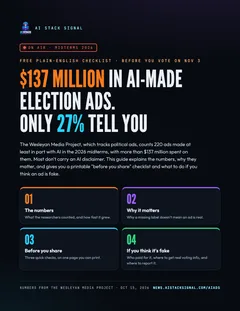
Free checklist · 6 pages · PDF
$137 million in AI-made election ads. Only 27% tell you
The numbers from the Wesleyan Media Project, why a missing AI label means nothing, a printable "before you share" checklist, and what to do if you think an ad is fake.
⬇ Download the PDFMore than $137 million. That’s how much has been spent this year on election ads made at least in part with AI, according to the Wesleyan Media Project, which tracks political advertising. Most of those ads don’t tell you AI was used. The midterms are on Tuesday, November 3, so here’s what the researchers found and three quick checks you can run on any clip before you share it. This is about every ad, from any side.
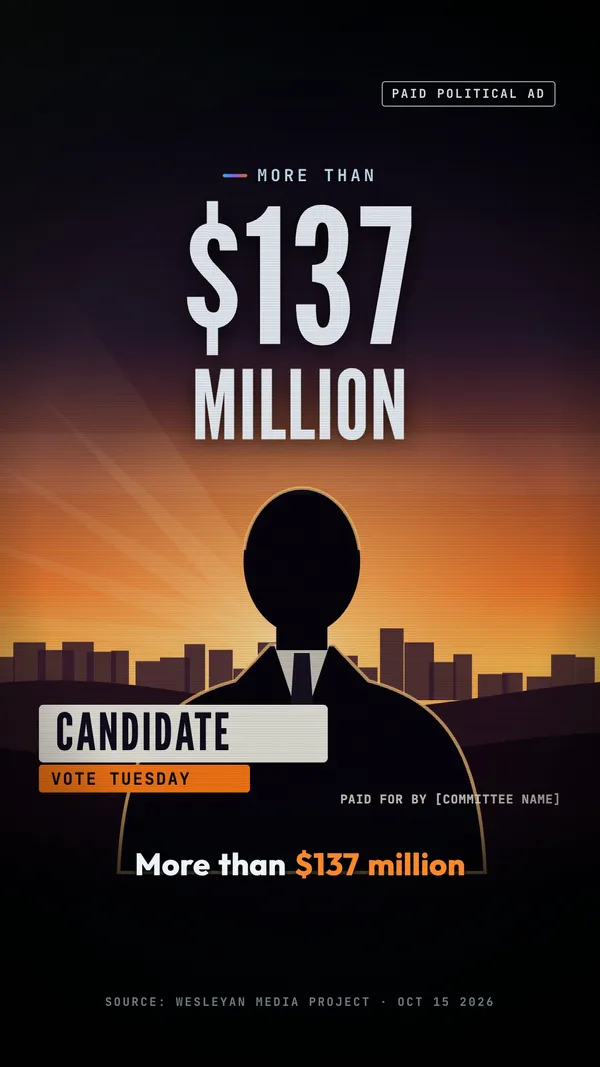
The numbers
The Wesleyan Media Project’s release of October 15, 2026 includes a section titled “Campaigns Spend More Than $137 Million on AI-generated Ads.” Here’s what it says, in the researchers’ own words:
- 220 ads, more than $137 million. “We now count 220 such ads in our database on which more than $137 million has been spent, and that is almost certainly an undercount given that it is difficult to detect uses of AI.”
- All over the country. AI-generated ads “have appeared across the country, showing up in 34 different states.”
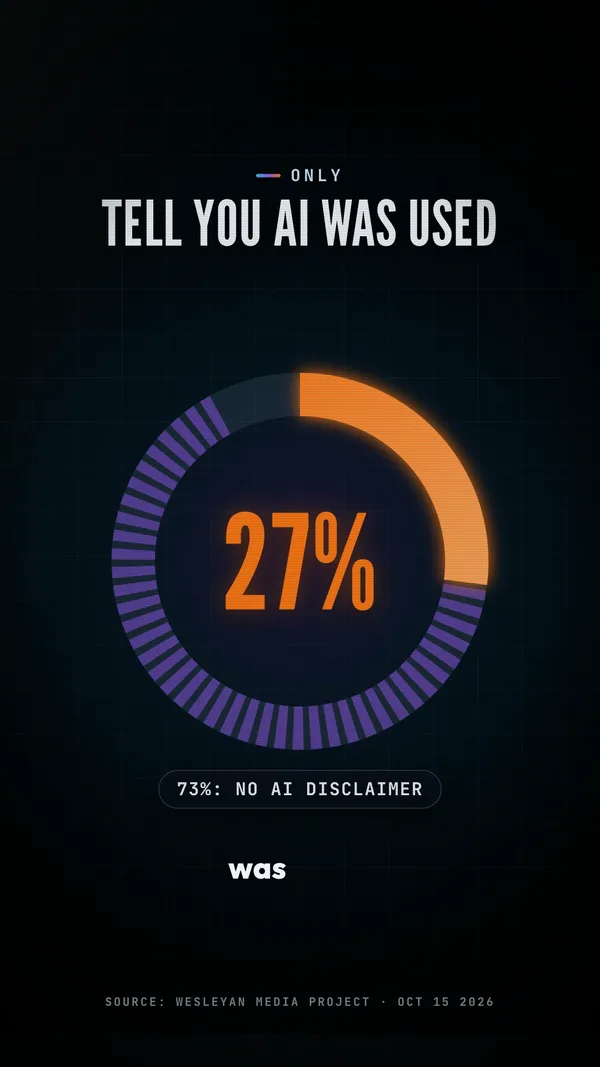
- Most don’t say so. “Twenty-seven percent of them contain a disclaimer.” That means roughly three in four don’t.
- A huge jump from 2024. Co-director Erika Franklin Fowler: “For comparison, we identified less than $50,000 in spending on AI-generated ads in the 2024 cycle.”
It’s also growing fast. On September 4, 2026, the same team counted “a minimum of 164 political ads generated or enhanced through the use of AI,” with spending “just under $80 million.” About six weeks later, that’s 56 more ads and more than $57 million more spent.
Takeaway
From less than $50,000 in 2024 to more than $137 million this cycle. Fowler put it simply: “AI is making its way into the 2026 midterms in a big way this year.”
Why it matters
Three lines in the report matter for anyone scrolling past political videos this week.
- Most AI use isn’t labeled. Fowler: “Much of the AI use is not disclosed through any type of disclaimer.”
- The real number is likely higher. “This tracking is undoubtedly an underestimate given there are a lot of ways in which AI might be incorporated that may go undetected.”
- Even the trackers can’t always tell. The researchers write that “sometimes it is difficult to discern whether an image was created by AI or not.” When they weren’t sure, they left the ad out, “and so our estimates of ad counts and spending are likely on the low side.”
One thing these numbers don’t say: which ads are false. An ad can use AI and still be accurate. The point isn’t that every AI ad is a lie. It’s that you usually can’t tell from the ad itself whether AI was used at all.
Takeaway
A missing AI label tells you nothing. If trained researchers can’t always spot it, you don’t have to either. You only have to check where a clip came from.
How the researchers count AI ads
Knowing how the count works helps you read it. According to the release, an ad goes on the Wesleyan list when it:
- says so in a disclaimer that it uses AI, or
- has been reported by news media or by AdImpact (the ad-tracking firm whose spending estimates the project uses) to include AI-generated or AI-enhanced content, or
- was flagged by the project’s coders as likely using AI and then confirmed by the team.
The spending figures are AdImpact’s estimates for each ad the team identified.
Takeaway
This is a count of ads the researchers could catch. The ones that slipped past are, by design, not in it.
Before you share: 3 checks
These three checks are our own plain advice, not findings from the researchers. They take less than a minute and don’t need any app.
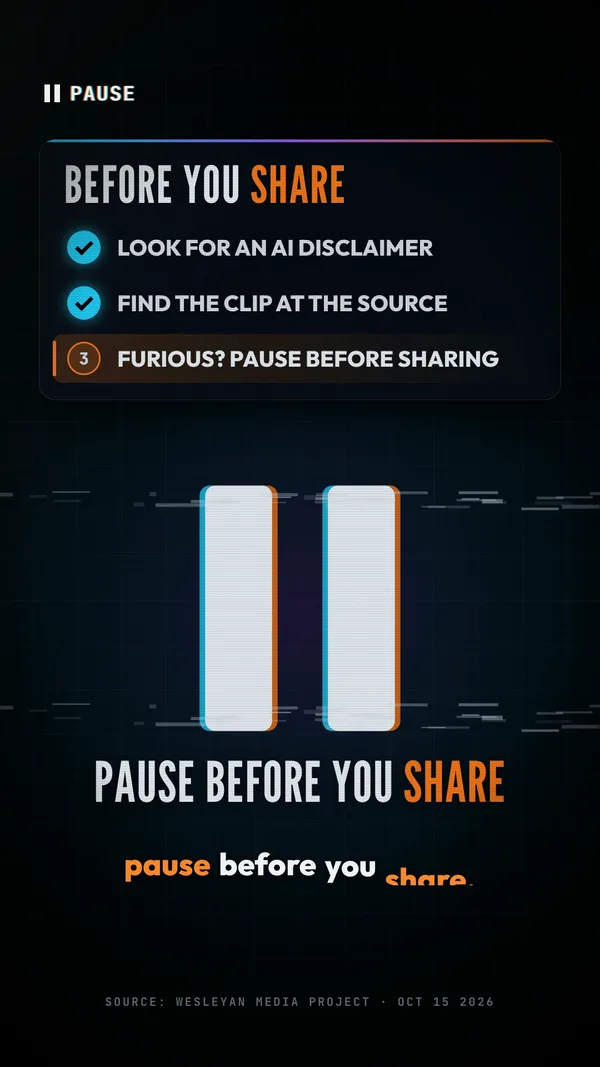
- Look for an AI disclaimer. Read the small print on screen and in the caption, and listen to the end of the ad. If you find one, you know AI was used, so judge the claim, not the picture. If you don’t, that proves nothing: only 27% of the ads counted had a disclaimer.
- Find the clip on the candidate’s own page, or a real news site. Search the candidate’s official website or account, or a news outlet you already know. Nowhere else? Be careful, and don’t share it until you can find where it came from.
- If it makes you furious in five seconds, pause before you share. A clip built to make you angry fast is built to be shared fast. Strong feelings are the moment to slow down.
Bonus check, from the FEC: look for who paid for it. Ads from federal campaigns and political committees must carry a disclaimer, and the FEC says it must be “clear and conspicuous.” When a candidate’s campaign pays, the notice “must state that the communication was paid for by the authorized committee.” When someone else pays, it “must identify the person who paid for it.”
Use case
Your uncle forwards a video of a candidate saying something outrageous, two days before the election. There’s no AI label, which tells you nothing. You search the candidate’s page and two news sites you trust, and the clip isn’t on any of them. You don’t forward it, and you send him a short note instead: “I couldn’t find that clip on the candidate’s page or any news site, and a lot of AI ads don’t say they’re AI. Might be worth checking before sharing it.”
Takeaway
You don’t need to spot the fake. You need to check the source, and give yourself five seconds before you hit share.
If you think an ad is fake
You can’t always prove an ad is fake, and you don’t have to. Here’s what you can do. Steps 1 and 4 are our tips; the rest come from official government pages.
- Don’t share it, even to say it’s fake. Reposting a clip to argue with it still shows it to more people. Describe it in your own words instead.
- Check who paid for it. Look for the “paid for by” line that FEC rules require on federal campaign ads (see the bonus check above).
- Get voting facts from your election office, not from an ad. If a clip tells you something about when, where or how to vote, check it with your state or local election office. USA.gov has an office finder “for help with registering, voting, and getting election results.”
- Report it where you saw it. Most apps let you report a post or an ad from its menu.
- For federal races, you can file a complaint with the FEC. The FEC says “Anyone can submit a complaint if they believe a violation of the law has occurred or is about to occur.” See its complaints process. In 2024 it also said the federal ban on fraudulent misrepresentation in campaigns “is technology neutral,” applying to “AI-assisted media” too.
Takeaway
Not passing it on is always an option, and it’s the one that helps most.
The fine print
- What the numbers count: ads the Wesleyan Media Project could identify as using AI, with spending estimates from AdImpact. They don’t say which ads are false.
- Non-partisan: this checklist applies to every ad, from any side.
- Our tips vs. theirs: the three checks, “don’t share it,” “report it where you saw it,” the use case and the note to a friend are ours. The numbers and quotes are the Wesleyan Media Project’s, and the official guidance quoted is the FEC’s and USA.gov’s.
- Federal rules: the FEC rules quoted here are federal. The FEC’s own site notes it is waiting to regain a quorum, so check fec.gov for its current status.
- Not connected: AI Stack Signal isn’t connected to the Wesleyan Media Project, the FEC or USA.gov, and this is general information, not legal advice.
Takeaway
Labels are rare and detection is hard, so the habit that works is simple: check the source, then pause.
Which of the three checks will you use first?
Sources & links 6
- Wesleyan Media Project: release of Oct 15, 2026, section "Campaigns Spend More Than $137 Million on AI-generated Ads" mediaproject.wesleyan.edu ↗
- Wesleyan Media Project: release of Sept 4, 2026 (earlier count of AI-made ads) mediaproject.wesleyan.edu ↗
- FEC: Advertising and disclaimers fec.gov ↗
- FEC: Complaints process fec.gov ↗
- FEC Record: Commission approves Notification of Disposition, Interpretive Rule on artificial intelligence in campaign ads fec.gov ↗
- USA.gov: State and local election offices usa.gov ↗
More on AI Tools for Creators, AI for Beginners, AI Safety & Regulation News