Signals/ Claude & Anthropic/ Reel /
Claude Now Hides a Watermark in the Words It Writes. Here's Who Can Check It
Anthropic says text from new Claude models now carries an invisible watermark, worldwide. It isn't hidden characters: a secret key shapes Claude's word choices into a pattern a detector can spot. Here's how it works, where it's on, who can apply for the detector, what it means for students, writers and businesses, and the catch.
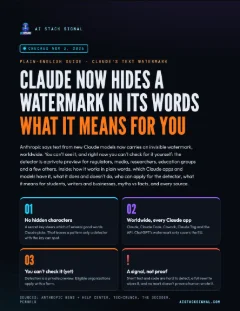
Guide · 7 pages · PDF
Claude text watermark guide
Plain-English pages: how the watermark works, which Claude apps and models have it, what it does and doesn't do, who can apply for the detector, what it means for students, writers and businesses, and every source.
⬇ Download the PDFIf you paste Claude’s writing into an essay, a client draft or a company report, that text now carries something you can’t see. Anthropic’s announcement puts it simply: “Future Claude models will generate text that contains a watermark.”
Two things make this one different. It’s on worldwide, not just in one region. And you can’t check for it yourself: the detector is a private preview for a short list of organizations.
Below is how it works, where it’s on, who can check it, and what it means if you write with Claude. Every fact comes from Anthropic’s own pages and news reports, checked on November 3, 2026.
What this actually is
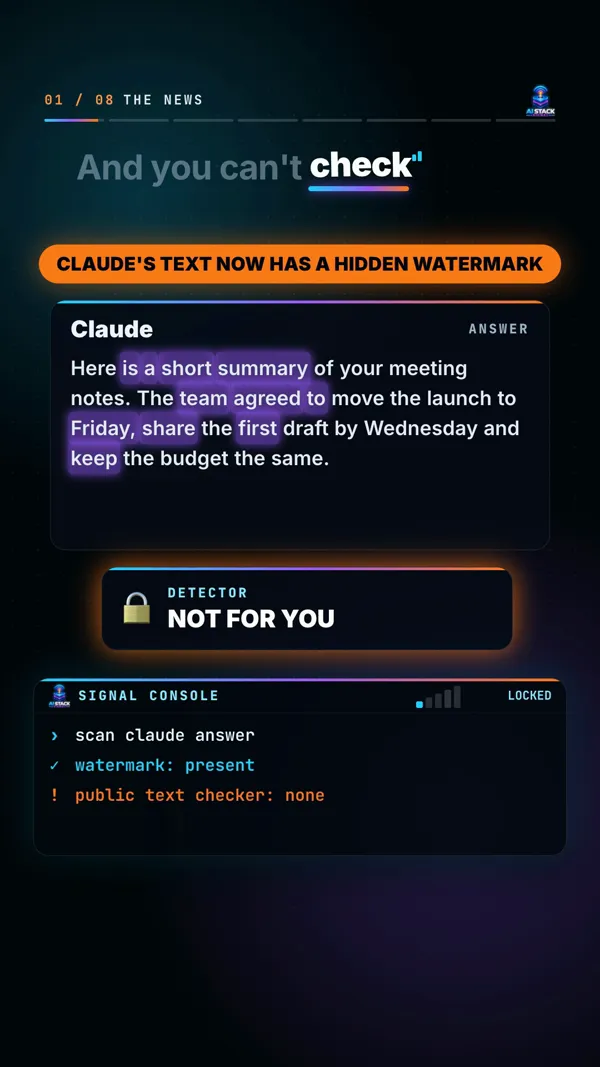
A watermark is a hidden mark that shows where something came from. Claude’s text watermark is a statistical pattern in the words Claude picks. You can’t see it by reading the text.
The basics:
- Announced: Anthropic’s post is dated August 14, 2026, and was updated on September 1 with details of the detection API. TechCrunch reported the plan on August 11.
- Which models: Anthropic’s Help Center says “New models will mark AI-generated content from day one.” PCWorld reported on September 1 that Fable 5.1 and Mythos 5.1 were the first to watermark. The Help Center table lists text watermarks for Fable 5.1, Fable 5, Mythos 5.1, Opus 5.5, Opus 5, Opus 4.8, Sonnet 5.5, Sonnet 5 and Haiku 5.5.
- Older models: “Anthropic is adding watermarks to outputs from models released before August 2, 2026,” over the coming months. Text written before the watermark existed carries no mark.
Why now. The EU AI Act’s Article 50 transparency rules apply from August 2, 2026. Anthropic signed the EU Code of Practice on Transparency of AI-Generated Content in July 2026, one of around 190 signatories.
OpenAI does something similar for ChatGPT in the EU. We covered that one, called textGrain, in our ChatGPT watermark breakdown. This page is about Claude.
Use case
You use Claude to draft emails, summaries and the odd paragraph for work. Nothing about how you use it changes. What changes is that the text it gives you now carries a mark that a few approved organizations can test for.
Takeaway
New Claude models mark their text from day one, older ones are being added, and the push comes from the EU AI Act.
How it works in plain words
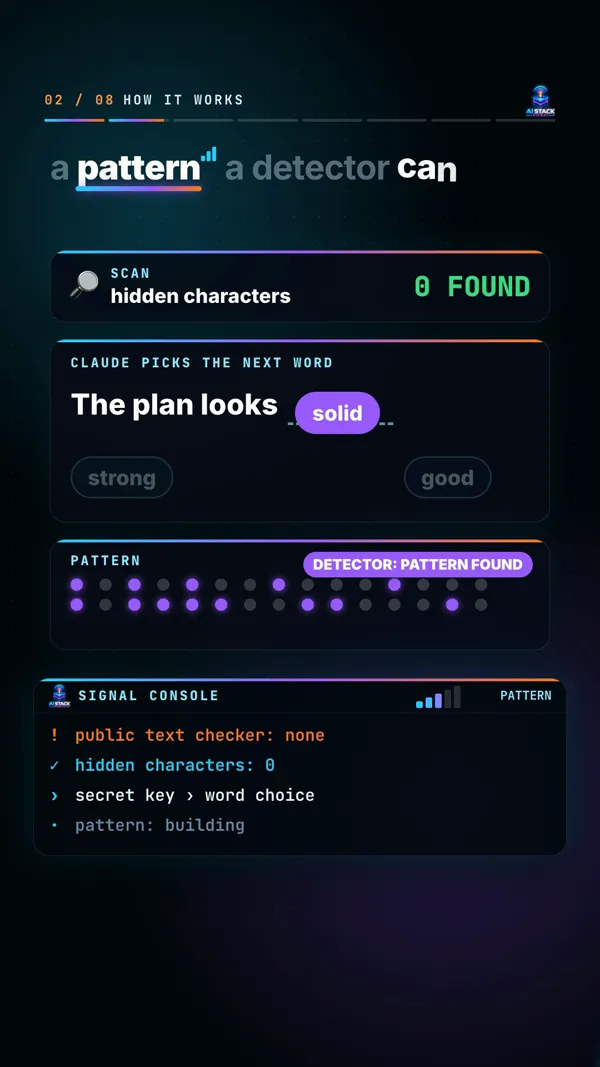
When Claude writes, it picks each next word from several words that would all fit. Normally a random number decides which one. With the watermark, a secret key plus the words that came before make that choice instead. Over a long passage, those choices add up to a pattern. Only someone holding the key can test for it.
In Anthropic’s words, the method “only changes the source of the randomness used to pick among words.” And: “Nothing is added to the text and there are no hidden characters.” It is based on Google DeepMind’s SynthID-Text method, published in Nature in 2024.
That means no secret symbols and no invisible spaces. The mark is in which words were chosen, not in extra characters.
Quality. Anthropic says it “does not impact the quality of Claude’s output.” Its Help Center says it doesn’t change meaning, quality or readability. The Decoder reports no effect “on the content, level of creativity, or readability.” Anthropic also says it doesn’t push Claude toward particular words.
Privacy. The mark “carries no identifying information and can’t be traced to a specific person, organization, or chat.” PCWorld adds that it contains no information about the user, their organization or their chats.
Prompt to try
Want to see the idea for yourself? Ask Claude to show you what “several words that would all fit” means:
Give me one sentence about a project plan, then list three other words that could replace the last word without changing the meaning. Explain in two plain sentences why a writer, or an AI, has to pick one.
That’s the choice the watermark works on. It doesn’t add anything you can see, so you won’t spot the mark in the answer.
Takeaway
No hidden characters. A secret key steers which good word Claude picks, and the pattern only shows up to someone with the key.
Where it’s on
Everywhere Claude writes. The Help Center lists the Claude Platform (the API), Claude, Claude Code, Claude Cowork and Claude Tag, “worldwide.”
Anthropic explains why it didn’t limit it to Europe: “We’re applying watermarking globally at launch because we don’t yet have a durable way to scope it by region.”
The ChatGPT contrast. TechCrunch reported on October 5 that OpenAI adds an invisible watermark to ChatGPT and Codex text, but only in the EU. Developers anywhere can switch it on in OpenAI’s API for select models, and it’s off by default there. So right now, Claude’s mark reaches further.
Files are different. Images and files from Claude (PNG, JPG, SVG and others) get a signed C2PA Content Credential instead. Anyone can check those for free at claude.com/check-files. That checker reads files only. It does not check text.
Use case
You run a small marketing shop in the US and assumed the EU rules didn’t touch you. Claude’s mark doesn’t depend on where you are, so text your team drafts with a new Claude model carries it too.
Takeaway
Worldwide, in every Claude app and the API. The free checker is for files, not text.
Who can check it, and how to apply
Detection needs Anthropic’s key, so it runs through Anthropic’s Detection API. The Help Center says it is “currently in private preview for eligible organizations.” PCWorld puts it bluntly: the watermark is “invisible to anyone who does not have the detection API.”
Anthropic’s list of who is eligible to apply:
- Regulators
- Law enforcement
- Media
- Fact-checkers
- Independent researchers
- Educational organizations
- EU civil society groups
- Enterprises with verification obligations under the EU AI Act
How to apply. Organizations on that list use Anthropic’s “Claude Watermark Detector Access Request Form” at forms.gle/9tGA33hPJJwtHsMk9. It’s linked from Anthropic’s news post and Help Center.
What’s not on the list: individual members of the public. There is no public text checker. Anthropic says it plans to expand access over time, but gives no timeline.
Workflow
- Check that your organization fits one of the groups above. Being eligible to apply doesn’t mean you’ll get access.
- Fill in Anthropic’s form as the organization, not as a private person.
- Wait for Anthropic. There’s no published timeline.
- Be wary of websites that say they can detect Claude’s text watermark. Reading it needs Anthropic’s key, and we found no source showing any outside site has it.
Takeaway
A short list of organizations can apply. You can’t check your own text, and neither can a random website.
What it means for you
Here’s the part that matters day to day. TechCrunch reports the watermark “will travel with the text when it’s copied and pasted elsewhere.” Anthropic says light editing probably won’t remove it, and the Help Center says it “may persist through some editing.”
So Claude’s words, pasted into an essay or a report, carry the mark. The facts above are Anthropic’s. The advice below is ours.
Students
Educational organizations are eligible to apply for the detector. That doesn’t mean your school has it today. Still, if you paste Claude’s paragraphs into an essay and change a few words, the mark is probably still there.
The simple rule: follow your school’s AI rules and say when you used Claude. If Claude only proofread your own writing, the Help Center notes a detected mark can mean the text was just processed by Claude, for example proofread, translated or summarized.
Prompt to try:
I used Claude while writing this essay. Here’s what I used it for: [brainstorming ideas / an outline / proofreading]. Write a short, honest note I can add for my teacher that says exactly that, in plain words.
Writers and freelancers
If a client’s contract says “no AI text,” a Claude draft can carry a mark. The good news: the mark carries nothing about who you are, so it can’t name you, your account or your chat.
Workflow:
- Ask each client up front how they feel about AI help.
- Put the answer in writing, in the brief or the contract.
- If you use Claude for drafts, say so where the client asked you to.
Businesses and marketers
Anthropic says quality doesn’t change, so nothing changes in how Claude writes for you. If you publish AI content in the EU, look at your own duties under the EU AI Act. Enterprises with verification obligations under that law are on Anthropic’s list and can apply for the detector.
Prompt to try:
Write a one-page AI writing policy for a 10-person marketing team. Cover: which tasks we use Claude for, when we tell clients or readers that AI helped, and who signs off before anything is published. Keep it in plain English.
Takeaway
Pasted Claude text carries the mark, and light edits probably won’t remove it. Being open about AI use is simpler than worrying about it.
The catch
Anthropic is clear about the limits. The Help Center: “Detection is a signal, not proof.” A detected mark means the content “may have been processed by Claude.” Claude might have written it, or only proofread, translated or summarized it.
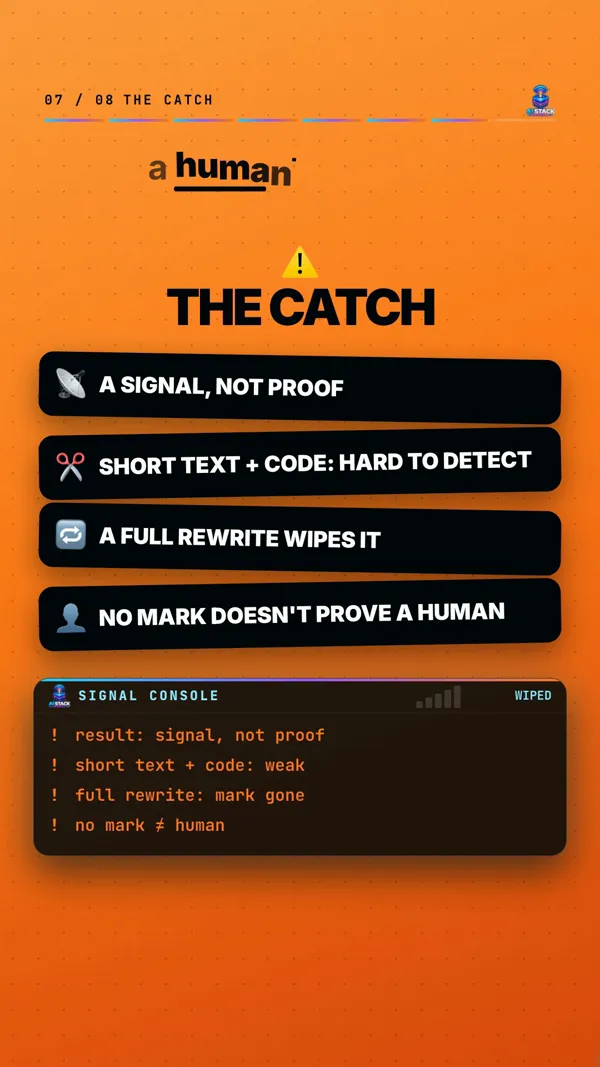
- It can’t tell writing from editing. Anthropic says it can’t separate “Claude wrote this” from “Claude heavily edited this.”
- Short text is hard. Detection is weak on small samples, and confidence rises with length.
- Code and exact answers are hard. Marks are sparse in code and in facts with one right answer, where there’s little word choice. The Decoder reports it is less reliable on short texts, fact-heavy passages and code.
- A full rewrite wipes it. Anthropic says a complete rewrite will remove it. The Help Center adds that heavy edits or paraphrasing can too.
- No mark doesn’t prove a human. A missing mark doesn’t rule out Claude: the text might come from an older model, or be heavily edited, translated or too short.
- No numbers. Anthropic publishes no accuracy rate, false-positive rate or minimum length for Claude’s detector. Be careful with anyone quoting one.
Use case
You’re a teacher or an editor and your organization gets detector access one day. A detection tells you Claude may have been involved, not that someone cheated. And a clean result doesn’t tell you a person wrote every word. Treat it as one clue, then talk to the writer.
Takeaway
A signal, not proof, in both directions.
The fine print
- New models first: older Claude models are still being added, and text written before the watermark carries no mark.
- No public text checker: the Detection API is a private preview, and Anthropic’s free checker reads files only.
- Our advice is ours: the tips for students, writers and businesses are AI Stack Signal’s suggestions, not Anthropic’s rules.
- Not connected: AI Stack Signal isn’t connected to Anthropic or OpenAI.
Takeaway
Every fact here comes from Anthropic’s news post and Help Center, plus TechCrunch, The Decoder and PCWorld, checked on November 3, 2026. Grab the PDF guide above for the full walkthrough and every source.
Sources & links 7
- Anthropic: Claude text watermark (Aug 14, 2026; updated Sep 1, 2026) anthropic.com ↗
- Claude Help Center: How Claude marks AI-generated content support.claude.com ↗
- Anthropic: Check if a file was made with Claude claude.com ↗
- TechCrunch: Anthropic says it will watermark text generated by its AI models (Aug 11, 2026) techcrunch.com ↗
- The Decoder: Anthropic announces watermark detection API that will let third parties detect Claude's AI texts (Aug 14, 2026) the-decoder.com ↗
- PCWorld: Claude's updated Fable and Mythos models watermark their replies (Sep 1, 2026) pcworld.com ↗
- TechCrunch: OpenAI will start watermarking ChatGPT's text in the EU (Oct 5, 2026) techcrunch.com ↗
More on Claude AI News, AI for Beginners, AI Safety & Regulation News