Signals/ AI for Beginners/ Reel /
It's Your Kid's Voice. It Isn't Your Kid: How AI Voice Clone Scams Work
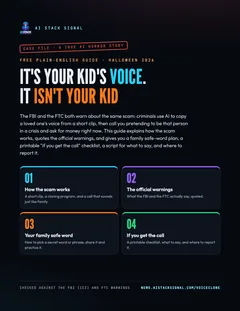
The FBI and the FTC both warn that criminals use AI to copy a loved one's voice from a short clip, then call pretending to be that person in a crisis and ask for money now. Here's how the scam works, what the official warnings say, a family safe-word plan, a printable checklist for the call, and where to report it.
Free guide · 6 pages · PDF
It's your kid's voice. It isn't your kid
How the voice clone scam works, the FBI and FTC warnings quoted, a family safe-word plan, a printable "if you get the call" checklist, a script for what to say, and where to report it.
⬇ Download the PDFIt’s Halloween, and the scariest call this year isn’t a ghost. It’s your kid’s voice, panicked, asking for help, and it isn’t your kid. The FBI and the FTC both warn that criminals use AI to copy a loved one’s voice and call you pretending to be that person in a crisis. The good news: the fix is simple, and you can set it up at dinner tonight.
How the scam works
Voice cloning means using an AI program to make new audio that sounds like a real person. The FTC calls the scam that uses it a “family emergency” scheme. Here’s how it works, in the agencies’ own words:
- They grab a short recording. The FTC says “All he needs is a short audio clip of your family member’s voice, which he could get from content posted online, and a voice-cloning program.”
- AI makes new audio in that voice. The FBI says “Criminals generate short audio clips containing a loved one’s voice.”
- A “relative” calls in a crisis. The goal, per the FBI, is “to impersonate a close relative in a crisis situation, asking for immediate financial assistance or demanding a ransom.” The FTC: “When the scammer calls you, he’ll sound just like your loved one.”
- They ask for money that’s hard to get back. The FTC says scammers ask you to pay “in ways that make it hard to get your money back,” like wire transfers, cryptocurrency or gift cards.
Takeaway
The scam doesn’t beat your ears. It beats your panic. The voice is the bait, and the rush to send money is the hook.
What the FBI and FTC say
The FBI (Internet Crime Complaint Center, public service announcement I-120324-PSA, December 3, 2024):
- “Create a secret word or phrase with your family to verify their identity.”
- “Listen closely to the tone and word choice to distinguish between a legitimate phone call from a loved one and an AI-generated vocal cloning.”
- Verify a caller “by hanging up the phone,” and if possible, limit online content of your image or voice, for example by making social media accounts private.
The FTC (consumer alert by Alvaro Puig, March 20, 2023):
- “Don’t trust the voice. Call the person who supposedly contacted you and verify the story. Use a phone number you know is theirs.”
- “If you can’t reach your loved one, try to get in touch with them through another family member or their friends.”
- “If the caller says to wire money, send cryptocurrency, or buy gift cards and give them the card numbers and PINs, those could be signs of a scam.”
Takeaway
Two US agencies, in 2023 and 2024, give the same core advice: don’t trust the voice, check through a channel you control, and be suspicious of hard-to-trace payments.
Make a family safe word
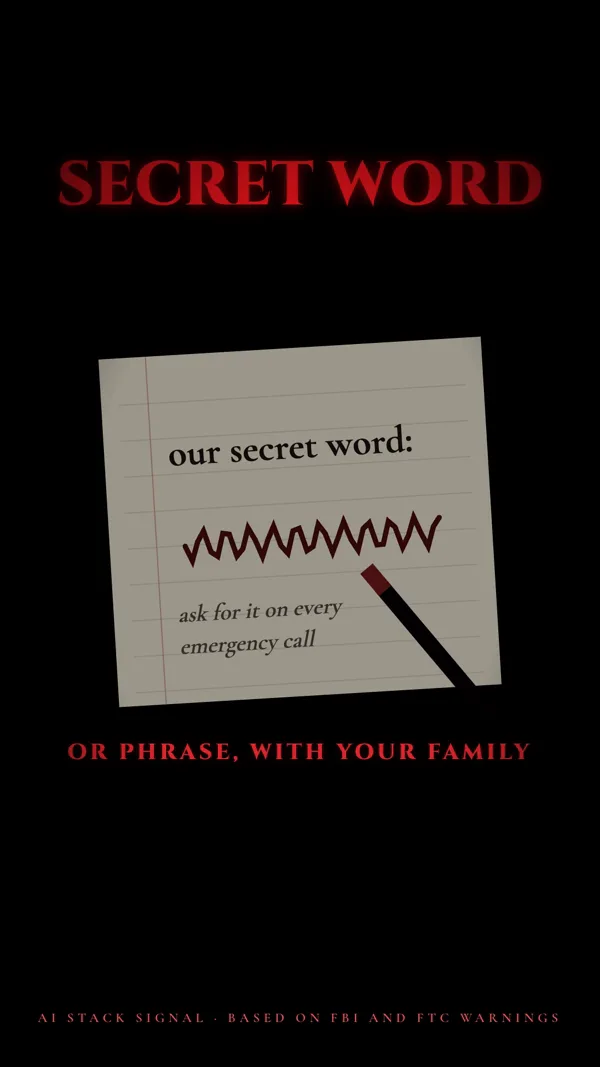
The FBI’s advice is one line: “Create a secret word or phrase with your family to verify their identity.” The steps below are our own how-to on top of that advice, not extra rules from the FBI or FTC.
- Pick something nobody could guess. Skip pet names, birthdays, street names, schools or anything that has ever been in a post or a photo caption.
- Make it easy to remember and odd to say. Two unrelated words work well, like an object and a colour. A stressed child or grandparent should be able to recall it, and nobody should say it by accident.
- Share it face to face, never online. Don’t text it, post it, email it or save it in a shared note. Include the people who’d actually get the call: grandparents, older kids, a babysitter you trust.
- Agree on the rule. “If you call me in trouble and ask for money, I’ll ask for the word. No word, no money, and I’ll hang up and call you back.”
- Never say it first. You ask, they answer. Don’t hint or offer choices. If the caller dodges, gets angry or says “there’s no time,” treat that as your answer.
- Practice once, change it if it leaks. Do a quick pretend call at the next family dinner. If anyone thinks the word was shared or overheard, pick a new one.
A safe word is one check, not the only one. Even if a caller gets it right, the FTC’s advice still stands: hang up and call back on a number you know is theirs.
Use case
Your mom is the one most likely to get this call, so you set it up with her first. At Sunday dinner you pick two odd words together, say the rule out loud, and do one pretend call where you “forget” the word. She hangs up and calls your real number. That’s the whole drill, and it takes five minutes.
If you get the call
Print this list from the PDF and keep it by the phone. When a loved one calls, panicked, and needs money right now:
- Don’t trust the voice. The FTC says a cloned call can “sound just like your loved one.”
- Ask for the family safe word. No word, or a dodge, means no money.
- Hang up. You’re allowed to end the call. The FBI says to verify a caller “by hanging up the phone.”
- Call back on a number you know is theirs. Use the number saved in your phone, not one the caller gives you.
- Can’t reach them? Reach someone else. Call another family member or one of their friends to check the story.
- Listen to how they talk. The FBI says to listen to “the tone and word choice.”
- Stop if they want a wire transfer, cryptocurrency, or gift cards with the card numbers and PINs. The FTC says those “could be signs of a scam.”
- Report it, even if you didn’t pay.
Takeaway
Every step on this list works without any tech. You don’t have to spot the fake voice. You only have to hang up and check.
What to say to the caller
Panic makes it hard to think, so here’s a short script (ours, not an official one). It’s polite, it works on a real loved one too, and it doesn’t argue with the caller.
"I hear you, and I want to help. What's our family word?"

(No word, a wrong word, or "there's no time"?)

"Okay. I'm going to hang up and call you right back on your
own number. If I can't reach you, I'll call [another family member]."

(They push for a wire, crypto or gift cards?)

"I don't send money that way. I'm hanging up now."
Then actually hang up, and call your loved one on a number you already have. A real family member will understand. A scammer will keep pushing, and that pressure is the sign.
Takeaway
Decide what you’ll say before the call ever comes. In the moment, you won’t have to think, only read.
Where to report it
- FTC: “If you spot a scam, report it to the FTC at ReportFraud.ftc.gov.” You can report a call even if you hung up and lost nothing.
- FBI: if you believe you’ve been a victim of financial fraud, the FBI asks you to file a report with its Internet Crime Complaint Center at ic3.gov.
If you can, the FBI asks you to include who contacted you (name, phone number, address, email), the money details (date, type of payment, amount, account numbers, the receiving bank, any crypto addresses), and what happened (how they first contacted you, why they wanted money, how they told you to pay, and what you told them).

Takeaway
Reporting helps even when you didn’t lose a cent. Write down the number, the time and what they asked for while it’s fresh.
The fine print
- These are official warnings about a type of scam, not a report on one case. We don’t share numbers on how common it is or how much people lose, because our sources don’t give them.
- Dates: the FTC alert is from March 2023 and the FBI warning from December 2024. The advice still applies, but check the sites for updates.
- Our tips vs. theirs: the safe-word how-to, the use case and the script are ours. The quotes and the core advice are the FBI’s and the FTC’s.
- Not connected: AI Stack Signal isn’t connected to the FBI or the FTC, and this is general information, not legal or financial advice.
Takeaway
No single check is perfect. Use the safe word and the call-back together, and you’ve closed the door this scam needs.
Have you set up a family safe word yet?