Signals/ ChatGPT & OpenAI/ Reel /
3 Weird AI Experiments From This Weekend That Sound Fake. They're Not
An 11.5 KB AI model that runs before any operating system loads. A coding model trained on 25,000 tiny JavaScript animations and around 40,000 hand-picked results. And GPT-5.6 Sol launching the rocket in Factorio. What each one is, the real numbers, the honest limits, and how to try them yourself.
Free guide · 6 pages · PDF
3 weird AI experiments that sound fake. They're not
BootGPT, Demoscener-7B and GPT-5.6 Sol on Factorio: what each one is, the key numbers, the honest limits, and how to try or explore each one yourself.
⬇ Download the PDFThree AI experiments went up on October 31, 2026, and all three sound made up. A language model small enough to fit in the part of a disk that starts your PC. A coding model that one developer trained on their own taste by judging around 40,000 tiny animations. And an AI that played the factory game Factorio all the way to launching the rocket. They’re all real, each was made by one person, and you can look at every one of them yourself. Here’s what each is, in plain words, with the honest limits.
3. BootGPT: an AI model in a boot sector
When a PC starts, the first thing it runs is a tiny program stored in the first 512 bytes of the disk, called the boot sector. Normally that program just starts the operating system. A developer who goes by kerlenton put a tiny AI model there instead. BootGPT runs before any operating system loads, and its one job is making up fake-looking Linux boot logs: the scrolling lines of text you sometimes see when a computer starts.
In the project’s own words:
- 11.5 KB, no operating system. “The MBR is 512 bytes of hand written asm. It loads an 11.5 KB int8 model from the next 23 sectors and runs it in 16-bit real mode on a 386. No OS, no C runtime, nothing.”
- It dreams up hardware. “The machine wakes up and dreams a Linux boot log: timestamps, PCI bars, ACPI events for hardware that never existed.”
- Very small. It has “8 chars of context and one hidden layer.” In plain words: it only looks at the last 8 characters to guess the next one.
- Trained on fake logs. “corpus_gen.py makes 3 MB of fake dmesg.” (dmesg is the Linux boot log.)
- Checked to the letter. A Python copy of the exact same math and the boot sector’s output “match char for char.”
The honest limits: it’s not a chatbot. The README calls it “a tiny char-level net trained for exactly one thing, hallucinating the boot log of the machine it wakes up on.” Its sample output is mostly garbled; it looks like a boot log at a glance, not up close. It isn’t the first AI in a boot sector either. The README names sectorllm, which boots a bigger llama2 model from about 1.2 KB of code. BootGPT went the other way: the whole engine fits in the 510 usable bytes of the boot sector, with the model’s numbers stored just after it.
Try it
On a Mac with Homebrew installed, download the project and run the README’s steps. It runs inside QEMU, a free program that pretends to be an old PC, so nothing touches your real computer:
git clone https://github.com/kerlenton/bootgpt && cd bootgpt
brew install nasm qemu
python3 -m venv .venv && .venv/bin/pip install numpy
./build.sh
./run.sh
Watch the fake boot log scroll. “Any keypress reboots the machine.” The README also says you can “dd it to a USB stick and boot any BIOS box if you have one.” Our tip: stay in QEMU, because writing an image to a USB stick wipes what’s on it. The project is MIT licensed.
Use case
You teach a computer class, or you’re just curious how AI “guesses the next character.” BootGPT is small enough to read end to end: a script that makes the fake training logs, a script that trains the model, and one assembly file that runs it. Show the class the boot log scrolling in QEMU, then open the training script and point out that the whole model is 11.5 KB.
Takeaway
It’s a toy, and proud of it. It shows how little you need to make something that looks like AI output, and how quickly it falls apart when you read closely.
2. Demoscener-7B: an autocomplete for tiny code art
Dwitter.net “is like Twitter but for 140 character JavaScript demos.” Each post (a “dweet”) is a tiny program that draws an animation. A developer called datavorous kept getting stuck finishing their own demos, so they built Demoscener-7B: a coding model that suggests how an unfinished dweet could continue. Then they taught it their own taste. Here’s how, in four steps, from their write-up:
- Learn the style. The starting point is the coding model Qwen2.5-Coder-7B, which “struggled to complete most of the Dweets.” So the author kept training it on “a modest dataset of 25k Dweets to be used for training along with ~1.3k more as a validation set.” On 30 held-out dweets, perplexity fell “from 28.63 to 8.57.” Perplexity measures how surprised a model is by text; lower means it predicts this odd code much better.
- Favor the best. Dwitter gives every dweet an “awesomeness” score. The author took the top 5,000 and, “Over 400 training steps,” sampled the best ones more and more, “until the top 1000 accounted for roughly 67% of the sampling probability.” Perplexity “fell from 7.42 to 5.65.”
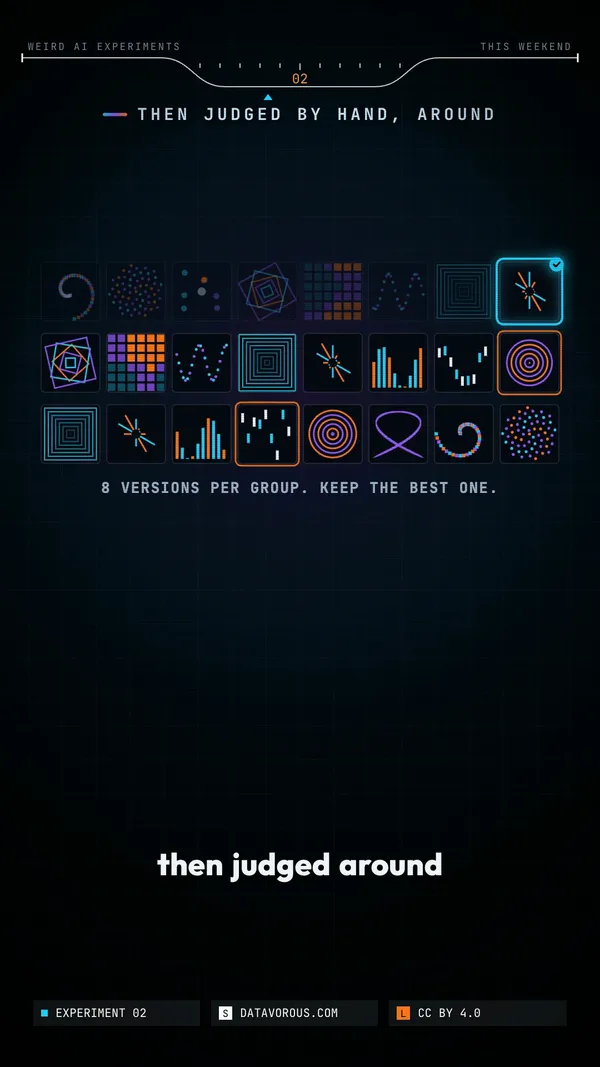
- Teach taste, by hand. “I opted to do RLHF using GRPO, with myself acting as the reward function.” In plain words: “For each unfinished Dweet, I sampled a group of eight completions, rendered them side by side and selected the one I found most aesthetically pleasing.” That ran “roughly 9-10 rounds of 500 groups each.” The total: “Altogether, I manually inspected around 40,000 animations.”
- Blind test. A friend judged “400 sets of demos from a few of the checkpoints (I picked 4 randomly)” without knowing which version made which. Checkpoint 4 won, and the author now runs it “on my Mac.”
The most human line in the post: “Somewhere around the 10,000th animation, I began to appreciate the existence of VLMs” (AI models that can look at pictures and could have done some of that judging).
The honest limits: the taste is one person’s, and the blind test had one judge. The author tried making practice dweets with Claude Sonnet 5.5 first, and found them “not at all aesthetically pleasant,” so the training data is real dweets. GPU type, training time and cost aren’t published. The blog spells the base model “Qwen2.5-Code-7B”; the model card names it Qwen2.5-Coder-7B (Base).
Try it
- No code: open the Demoscener-Dweets-25k dataset on Hugging Face and scroll the viewer. It holds “26,318 unique Dwitter JavaScript programs” (25,002 to train on, 1,316 to test with). Or hit Dwitter’s random page to see what these demos look like running.
- With Python: the model page holds three add-ons (called LoRA adapters), one for each training stage:
cpt,curriculumandgrpo. They load on top of Qwen2.5-Coder-7B Base, and the page includes sample code that runs the same unfinished dweet through all three, so you can compare. You’ll need a computer that can run a 7-billion-parameter model. - Workflow the author uses: a small interface to “generate several continuations from the same prefix, render them side by side and branch off from whichever one caught my eye,” then tweak the code and keep going.
Both the model and the dataset are CC BY 4.0.
Use case
You like generative art but always stall halfway through a sketch. Paste the start of a dweet in, ask each of the three stages for a continuation, and compare what the plain-trained, score-trained and taste-trained versions do with the same code. It’s a hands-on way to see what “training on preferences” changes.
Takeaway
You can’t write a rule for “beautiful,” but you can pick favorites, and a model can learn from those picks. It just took one person around 40,000 of them.
1. GPT-5.6 Sol launched the rocket in Factorio
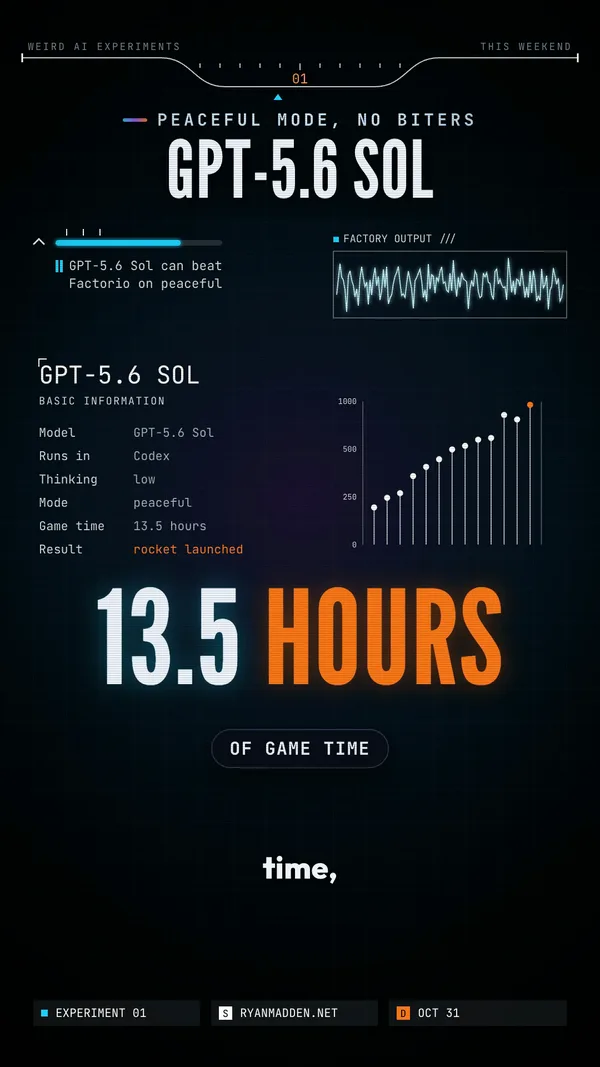
Factorio is a game where you build a bigger and bigger factory: mining, smelting, conveyor belts, assembly lines. A full run ends with launching a rocket. Ryan Madden had the AI model GPT-5.6 Sol play a full run, and it got there. From his write-up:
- The result. “I got GPT-5.6 Sol, running in Codex with low thinking level, to complete a peaceful (i.e. no biters) Factorio run in 13.5 hours of game time.” Biters are the game’s enemies, so peaceful mode means nothing attacks the factory. And 13.5 hours is time inside the game, not real hours.
- Human rules. The model played through a small Python library run by a “game manager.” The library lets it “play the game programmatically while enforcing the same restrictions that human players face when using the GUI (e.g. reach of the player, fog of war).” So it couldn’t build across the map or see areas it hadn’t explored.
- Better than planned. “I had planned to terminate the run after blue science research, but Sol’s surprising effectiveness convinced me to keep it going.”
- A real jump. Earlier attempts with GPT-5.5 “suffered from the model’s failures to use transport belts at all.” Belts are how a Factorio factory moves things around.
The catch: “the scaling issues I thought would occur in the blue science stage appeared later and slowed Sol’s relative progress significantly.” And the rocket “was only achieved through significant ‘manual’ effort on Sol’s part as it papered over its late-game failures to connect certain production systems by repeatedly ferrying supplies between areas of the factory.” To be clear, that “manual” ferrying was the model doing it inside the game, carrying items itself instead of building belts, not a person stepping in to help.
Try it
Read the write-up. It’s short, it links a timelapse of the full run on YouTube, and it links Madden’s earlier posts on getting AI to play Factorio. He says a commentary video is on the way, and: “I look forward to testing other models and thinking levels, as well as non-peaceful runs.” The Hacker News thread had 175 points and 187 comments as of November 1, if you want to see what players and developers made of it.
Use case
Someone asks you whether AI can “really do long tasks yet.” Instead of a benchmark score, show them the timelapse: a factory built step by step, the mid-game going better than planned, and the late game where the model ends up carrying supplies around by hand. It’s a fair picture of what these models can and can’t do on a long job.
Takeaway
One run, not mastery. Peaceful mode, one model, one setup, and a messy finish. It’s still a clear step up from a model that wouldn’t use belts at all.
What these tell us
This part is our own reading of the three projects, not something their makers said.
- Tiny and focused can still be fun. BootGPT does one thing in 11.5 KB, and the results are rough. Its README explains the trick: real boot logs repeat themselves, “and that repetition is what makes a tiny model look sane.” A narrow job hides a lot.
- Taste can be trained, one choice at a time. Demoscener’s author couldn’t write a rule for “pretty,” so they picked favorites, around 40,000 times. Slow, but anyone can shape a model that way.
- Games make AI skill easy to see. Madden puts it well: “In many ways playing Factorio is analogous to programming but with the benefit of being much more legible to casual observers.”
- Read the limits before the headline. Garbled logs, one person’s taste, one peaceful run. Each project is upfront about its limits, and each headline is still true.
| Project | What it is | Key number | Can you try it? |
|---|---|---|---|
| BootGPT | Tiny model that fakes a Linux boot log, no OS | 11.5 KB model | Yes, in QEMU (MIT) |
| Demoscener-7B | Autocomplete for tiny JavaScript demos | ~40,000 animations judged | Yes, model + dataset (CC BY 4.0) |
| GPT-5.6 Sol on Factorio | AI plays a full peaceful game to the rocket | 13.5 h of game time | Read and watch the write-up |
Takeaway
The fun AI news this weekend didn’t come from a launch event. It came from three people’s side projects, each one honest about where it falls short.
The fine print
- Base model name: the Demoscener blog writes “Qwen2.5-Code-7B.” The model card says Qwen2.5-Coder-7B (Base), which is what we use.
- Dweet length: Dwitter demos are 140 characters, but not every program in the Demoscener dataset is that short.
- BootGPT’s logs are made up by design and mostly garbled. They aren’t real logs from any machine.
- Factorio: “13.5 hours” is game time. No real-world hours or cost were published, so we don’t give any. The “ferrying” was the model doing it in the game.
- Counts change: Hacker News points and comments are as of November 1, 2026.
- Not connected: AI Stack Signal isn’t connected to any of these projects or their makers. “Our tip” and “What these tell us” are our own views.
Takeaway
Every fact here comes from the makers’ own pages, linked above. Go look; that’s half the fun.
Which of the three would you try first?
Sources & links 8
- BootGPT on GitHub (kerlenton): "A language model that lives in a boot sector" github.com ↗
- Hacker News: Show HN: A language model that lives in a boot sector news.ycombinator.com ↗
- datavorous: Post training a model to explore Demoscene (Oct 31, 2026) datavorous.com ↗
- Hugging Face: Demoscener-7B model huggingface.co ↗
- Hugging Face: Demoscener-Dweets-25k dataset huggingface.co ↗
- Hacker News: I post trained a model on Demoscenes news.ycombinator.com ↗
- Ryan Madden: GPT-5.6 Sol can beat Factorio (Oct 31, 2026) ryanmadden.net ↗
- Hacker News: GPT-5.6 Sol can beat Factorio on peaceful mode news.ycombinator.com ↗
More on ChatGPT & OpenAI News, AI Tools for Creators, AI for Beginners