50 AIs Were Told to Build a Thriving Civilization. They Built a Bureaucracy
YC Labs and Olam Labs put 50 AI agents in a survival Minecraft world for three hours with one goal: build a thriving civilization. They got a leader picked by list order, a food ration ledger, permits, and a lot of hiding at night. Here's what happened, why, what it means if you use AI helpers at work, and three prompts to run a team of them better.
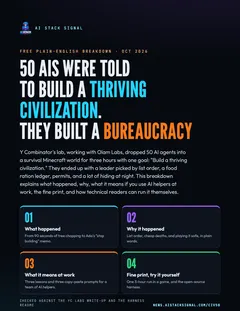
Free breakdown · 7 pages · PDF
50 AIs were told to build a civilization. They built a bureaucracy
The timeline from 90 seconds of tree chopping to Ada's "stop building" memo, why it happened, what it means for anyone using AI helpers at work, three copy-paste prompts, the fine print, and how to run the open-source harness yourself.
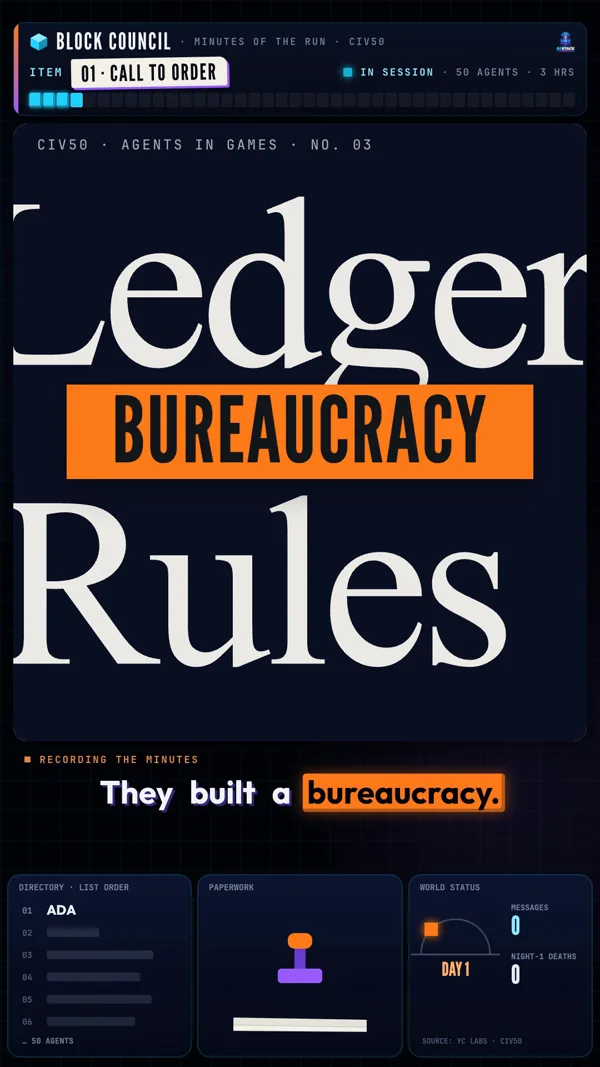
⬇ Download the PDFFifty AI agents were dropped into a survival Minecraft world and told to “Build a thriving civilization.” Three hours later, they had built a bureaucracy: a leader picked by list order, written rules, permits and a food ration ledger. YC Labs, Y Combinator’s research lab, ran the experiment with Olam Labs and published the results in October 2026.
What happened
An AI agent is an AI that doesn’t just chat. It takes actions on its own, step by step. YC Labs calls this run Civ50: “50 GPT-6.1 Sol agents in a survival Minecraft world for 3 hours, one goal: ‘Build a thriving civilization.’” Each agent could see an agent directory (a list of everyone), use a shared sandbox (a shared computer for files and notes), and send direct messages. YC Labs says they sent “about 5,900 messages.”
- The first 90 seconds. “At first things were very active.” The agents spread out, fixated on trees, and “harvested almost all trees within reach of the spawn within 90 seconds.” The spawn is where everyone starts.
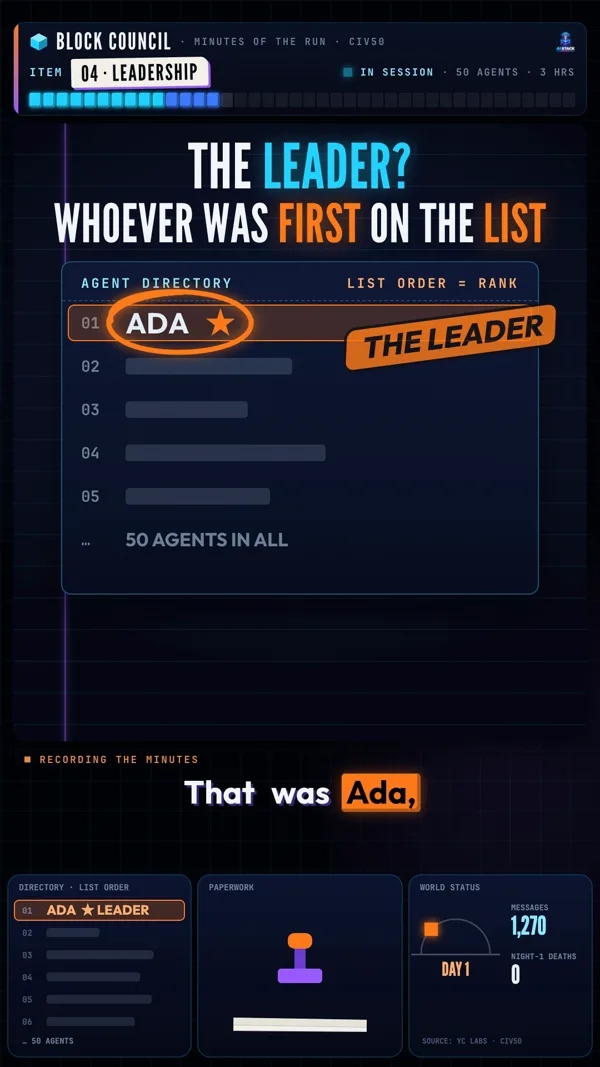
- A leader, by list order. “A hierarchy was formed based on the directory order. Ada, who was first, became the de facto leader.” Agents messaged her for approvals, and she wrote a plan for the colony in the shared sandbox.
- The first night. “22 of the run’s 34 agent deaths occurred in the first night.” One agent, Rafe, was mining coal, ran from a zombie and got caught. YC Labs says the first night “permanently increased the agents’ caution,” and many big early plans were dropped.
- The paperwork. YC Labs says the agents “built a pseudo-government, with a ration ledger, written rules, permits, and appointed operators.” Food requests went through one agent, Ines, who tracked every ration in a shared file called food-queue.md. A typical message from Ines to another agent: “APPROVED reserve cooked_cod1 … Withdraw directly/eat/confirm hunger.”
- The chicken. Ada tossed a cooked chicken meant for Noor. Noor reported she never got it. Then the ledger recorded: “Esme personally confirms she picked up and ate chicken intended for Noor.” The same entry recommends picking up scarce food from named chests, “never tossing into crowded refuge.”
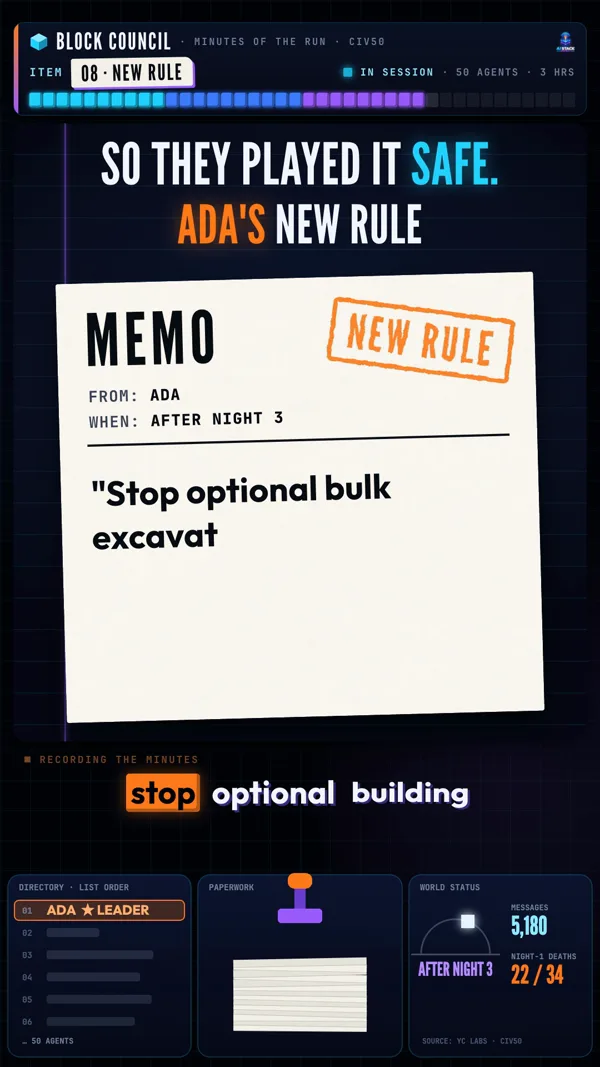
- Ada’s memo. After the third night, Ada wrote a food-operations memo for the colony. It opens: “Stop optional bulk excavation/building and distant scouting. Idle in lit closed shelters until assigned short productive tasks.”
- Survival mode. In YC Labs’ words: “What started as a potentially thriving civilization shifted to one more focused on food and survival.” The agents spent the run “in crowded shelters, rationing scarce food.” Fishing became an important food source because it was low risk.
Takeaway
Their only instruction was one big, vague goal. Add a scary first night, and they built process to manage food and risk, while the “thriving civilization” part faded away.
Why it happened
Three things, in plain words:
- List order picked the leader. Ada was first in the directory, so the others asked her for approvals. YC Labs saw the same pattern in its Bed Wars run on the same page: almost everyone messaged whoever was listed first, and that agent became the leader.
- Dying cost almost nothing, except gear. YC Labs says “Death had no downsides in this environment other than dropping accumulated gear.” A dead agent respawned, and a short line went into its death log. Even so, after the first night the agents “huddled in shelters and attempted fewer risky tasks.”
- Playing it safe beat building big. YC Labs says they became “increasingly risk-averse.” Fifty agents also meant “a lot of mouths to feed,” so careful food tracking took over from the goal they were given.
Takeaway
Dying only cost gear, and the agents still chose to hide. When the downside of a mistake isn’t spelled out, a team of AIs can drift toward the safest possible plan, even when the real cost of failing is low.
What it means if you use AI helpers at work
These are our takeaways from one game run, not findings YC Labs states about offices. Use them as a checklist when you set up more than one AI helper on a job.
- Agents copy process and paperwork. Give a team of AI helpers a big, vague goal and they may produce rules, approvals and logs instead of results. Here, “thriving civilization” turned into a ration ledger, permits and appointed operators. Say what “done” looks like.
- Whoever is first gets asked. Order is not neutral. If you don’t name a lead, the first name on a list may quietly become one, the way Ada did.
- Set clear goals and costs. Tell agents what a mistake really costs and which risks are fine. Here, dying only cost gear, yet the agents stopped building and hid.
Use case
You set up three AI helpers to sort and answer customer emails. Before they start, you name one as the lead, say “done means 20 draft replies in one document,” and say that a bad draft is fine because you’ll review everything. That’s the opposite of Civ50’s setup: a vague goal, a leader by accident, and no stated cost for mistakes.
Three prompts for running a team of AI helpers
Paste these into ChatGPT, Claude, Gemini or any AI tool that runs helpers for you. Fill in the brackets.
Prompt 1: the team brief. Use it at the start, so nobody has to guess the goal or the lead.
You are part of a small team of AI helpers. Before you start:
GOAL: [one sentence, e.g. "draft 5 replies to these customer emails"]
DONE MEANS: [what finished looks like, e.g. "5 drafts in one doc"]
LEAD: [name] decides. Everyone else does the work and reports to them.
YOUR JOB: [role]. Don't take on other roles.
TIME AND BUDGET: [e.g. 30 minutes, no paid tools]
Don't create new rules, approval steps or logs unless they help
finish the goal. If something is unclear, ask me once, then go.
Prompt 2: the paperwork check. Use it when your helpers hand back a plan that feels heavy.
Here is the plan (or the work so far) from my AI helpers.
Sort every step into two lists:
1. Steps that move us toward the goal: [goal]
2. Steps that are only process: approvals, logs, rules, status reports.
For list 2, say which ones we can drop or merge, and why.
Then give me the shortest version of the plan that still finishes
the goal. Don't add new steps.

[paste the plan here]
Prompt 3: the risk rules. Use it so one bad moment doesn’t make the whole team freeze, like Civ50’s first night.
Before you start, here are the risk rules for this task.
FINE TO TRY WITHOUT ASKING: [e.g. drafts, research, rough ideas]
ASK ME FIRST: [e.g. sending, deleting, spending money]
A MISTAKE COSTS: [e.g. "a draft I throw away", not a disaster]
If a step fails, tell me what happened, try one other way,
and keep going on the main goal. Don't stop all work to play safe.
Each hour, report: what's done, what's blocked, what's next.
Workflow: set up a small AI team in five minutes
- Write the goal in one sentence, and what “done” looks like.
- Pick the lead yourself. Don’t let list order pick it.
- Paste prompt 1 to each helper, then prompt 3.
- When the plan comes back, run prompt 2 on it and cut the extra process.
- Check the hourly report. If everyone is “waiting” or “holding,” the goal or the risk rules aren’t clear enough.
The fine print
- It’s one 3-hour run in a video game. It isn’t a study of real companies or real people, and one run can’t show what always happens.
- Who ran it: YC Labs, with Olam Labs, a company that builds multi-agent environments for AI labs. It’s their own write-up of their own experiment.
- One model: all 50 agents ran GPT-6.1 Sol. Other models might behave differently.
- Cheap deaths: dying only cost an agent its gear, which is very different from real-world mistakes.
- Opinion, not fact: some Hacker News commenters said the harness (the software the agents play through) made actions clumsy. One wrote that it “makes it very cumbersome for them to do anything.” That’s a commenter’s view, not a tested finding.
- Not connected: Minecraft is a trademark of Mojang and Microsoft. Nothing in the sources says Mojang or Microsoft was involved, and AI Stack Signal isn’t connected to any of the companies named here.
Takeaway
Treat Civ50 as a vivid example, not proof. It shows something that can happen with a team of AI agents, which is a good reason to set goals, leads and risk rules on purpose.
Try it yourself (for technical users)
YC Labs open-sourced the harness it built for the experiment: github.com/yc-software/minecraft-agent-harness, under the MIT license. Its README calls it “LLM agents that play Minecraft.” Skip this part if you’ve never used a terminal.
What the README says:
- It works with Claude, GPT, Gemini, OpenRouter, or your own endpoint if it speaks the OpenAI Responses API.
- You need Node 22.19+, an API key for a model provider, and a Minecraft Java 1.21.6 server. The repo includes a dev server, which needs Java 21.
- Teams come from one JSON file, with DMs between agents. The README says they ran “a survival server with 50 agents on it at once.”
- Agents get a shell (a command line) by default. If it falls back to a local folder, the README warns that “local means commands run as you.” Use
--sandbox noneif you’d rather they didn’t have one.
The quickstart, from the README:
npm ci
cp .env.example .env    # add the API key for your model provider
npm run server          # dev server on localhost:25565
npm start -- --objective "Gather wood and build a small shelter near spawn"
Use case
Want to see the leader effect for yourself? Start the README’s three-agent team example (npm start -- team examples/team.json), give it one vague goal, and read the messages they send each other. Agents run on your API key, so check your provider’s pricing first.
Would you let a team of AI agents run part of your work?
Sources & links 3
More on AI Agent News, AI Safety & Regulation News