Signals/ Google Gemini/ Reel /
Google Asked a Computer in Space to Write a Poem, and It Answered
Google's Project Suncatcher test satellite carries four of its data center AI chips. Its Gemma 4 model wrote a haiku in orbit and sent it back down over Norway. Here's what happened, what's on board, why Google is trying this, the fine print, and how to read the next big AI announcement.
Free breakdown · 6 pages · PDF
Google put an AI chip in orbit and it wrote a poem
The timeline from launch to the haiku, what's on board, why Google is trying this, the fine print, what's next, and a 4-point checklist with a copy-paste prompt for reading any big AI announcement.
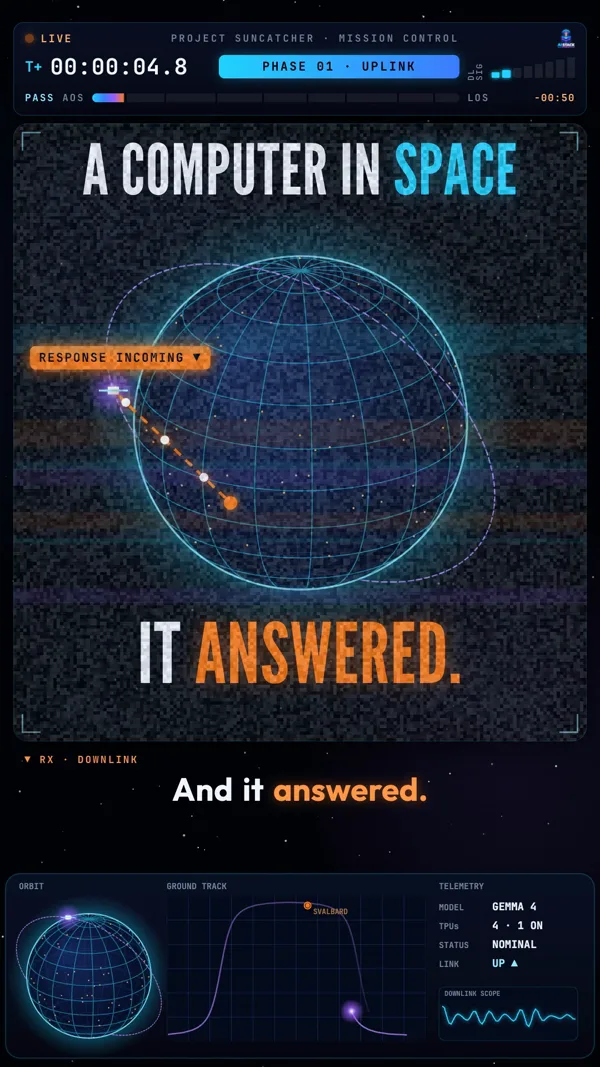
⬇ Download the PDFGoogle just asked a computer in space to write a poem, and it answered. The computer is a test satellite for Project Suncatcher, carrying four of Google’s data center AI chips. The poem is a haiku, written by Google’s open AI model Gemma 4 while in orbit, and sent back down to Earth.
What happened
Google announced the news on October 30, 2026, in a post by Travis Beals. Google calls the satellite the “first step in our long-term research moonshot to explore powering AI compute in space.”
- October 1: launch. Google says the prototype satellite launched “On October 1.” TechCrunch reports it went up on a SpaceX Falcon 9 rocket “alongside more than 100 other spacecraft,” and that Planet Labs built the satellite.
- The following weeks: commissioning. That’s the step where a new satellite’s parts are switched on and checked before real work starts. Google says the team worked through a checklist, including powering up the chip trays and running early machine learning tests. TechCrunch puts it at about three weeks.
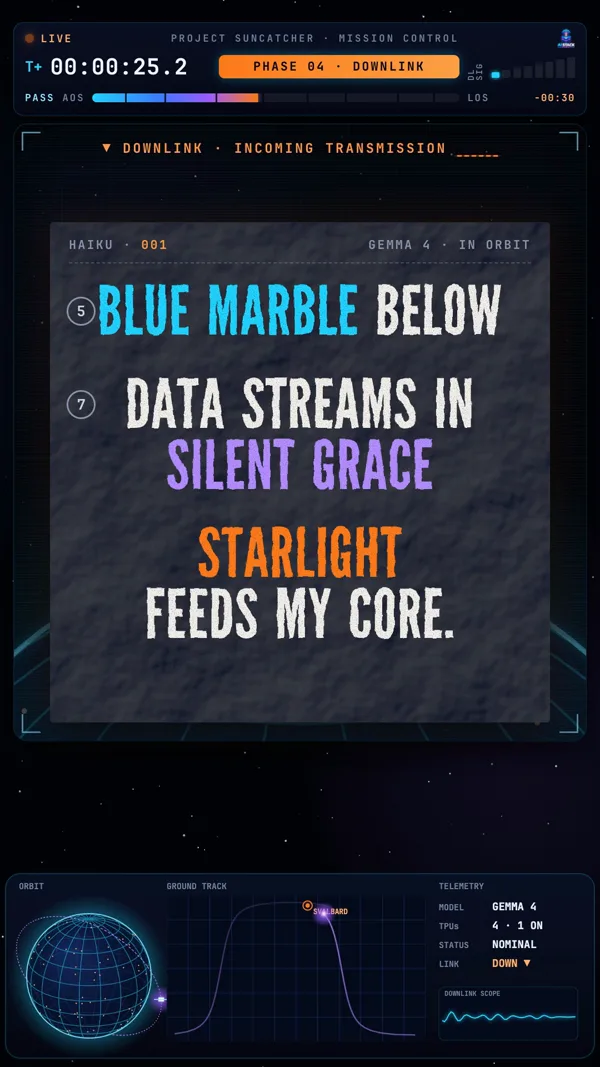
- “Hello World”: the haiku. The team sent a prompt up to “our onboard Gemma 4 open model,” asking for “a haiku about being in space.” Google says: “As the satellite passed by Svalbard, Norway, the downlinked poem confirmed success.” This is the poem:
Blue marble below
Data streams in silent grace
Starlight feeds my core.
- After that: Google says the team also tried limericks and prompts that report on the satellite’s own systems. A Google spokesperson told TechCrunch the satellite is “operating nominally,” meaning it’s working as planned.
Google calls it the “first-ever AI response from a data center class TPU in orbit.” That’s Google’s own description of its own milestone.
Takeaway
The real news isn’t the poem. It’s that a data center AI chip survived launch, switched on in orbit, ran a model and sent an answer back. A haiku is just a friendly way to prove that.
What’s on board
A TPU (Tensor Processing Unit) is Google’s own kind of AI chip, the type it uses in its data centers. According to TechCrunch:
- The satellite carries “four Google Tensor Processing Units (TPUs).”
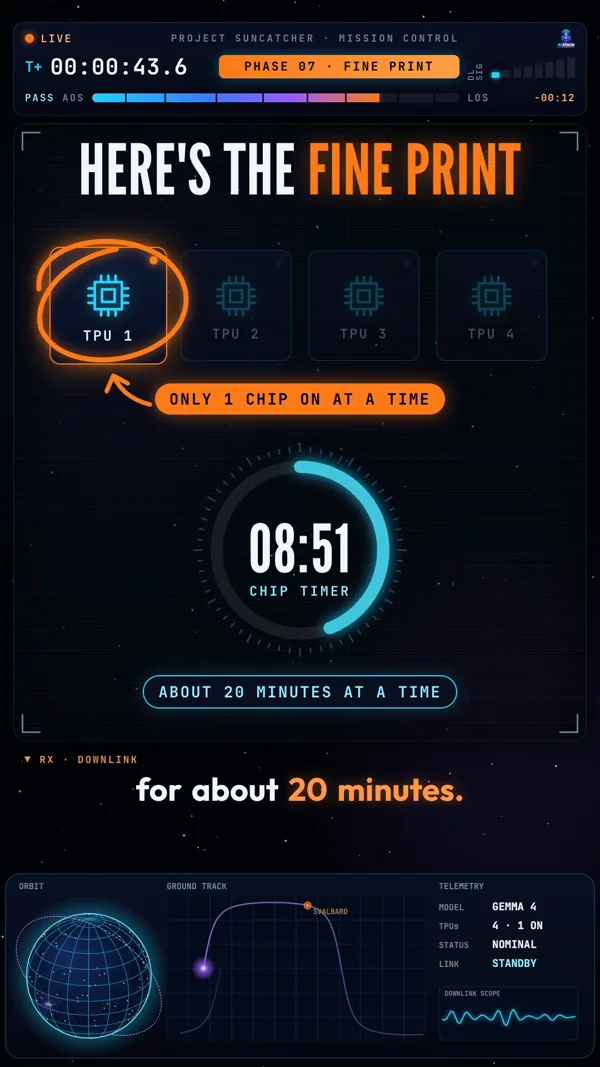
- It makes “up to 1 kW” of electricity. The chips need a lot of power, so each one can run for only about 20 minutes at a time.
- After a correction, TechCrunch’s report says the satellite “can only operate one at a time.” So four chips are on board, but only one works at any moment.
- The Gemma 4 model was loaded onto the satellite before launch. TechCrunch also notes that the short run time makes communication between the satellite and the ground harder.
Use case
A friend says “Google has AI data centers in space now.” You can answer precisely: one test satellite, four chips, one chip running at a time, for about 20 minutes. Impressive as a first step, but not a data center yet.
Why Google is trying this
Google calls Project Suncatcher a moonshot: a long shot that could pay off big. In Google’s words, the goal is “to explore powering AI compute in space.” In plain English: one day, running big AI computers up there and not only on the ground.
TechCrunch adds more detail. The plan is networks of satellites flying close together that run large AI workloads in orbit, connected by high-speed links between the satellites. TechCrunch describes it as a long-term project aimed at making this economical in the 2030s.
Try this prompt
Want to understand a moonshot like this without the hype? Paste the company’s announcement into any AI chat with this:
Explain this announcement to me like I'm smart but not technical.
What is the long-term goal, in one sentence?
What has actually been done so far, in one sentence?
How many years away does the company itself say the goal is?
Quote the sentences you used, and write "not stated" if it doesn't say.
The fine print
- It’s a test, not something you can use. Nobody can sign up for AI in space. One satellite showed it can run one chip at a time, for about 20 minutes, and answer a prompt.
- What the poem proves: the chip and the model work after launch and can send an answer back down. Google calls this a “Hello World” milestone, the classic first test that a new system runs at all.
- What it doesn’t prove: that the chips hold up over time in space. That’s what the next tests are for.
- What neither source tells us: how high the satellite flies, which generation of TPU it carries, how fast the answers come, what it costs, or where its power comes from beyond TechCrunch’s “up to 1 kW.” We don’t guess at those.
Takeaway
When a story says “first-ever,” check who says so. Here it’s Google describing its own result, and the details that make it sound smaller (one chip at a time, about 20 minutes) came from TechCrunch’s reporting.
What’s next
- Heat and radiation tests, now. Google plans “tests to evaluate how TPUs perform under thermal stress and radiation exposure in orbit.” TechCrunch explains that radiation can cause “bit flips,” tiny errors that quietly corrupt data. TechCrunch says ground tests suggested little effect on running a model, but more on training one. Orbit will show if that holds.
- Two linked satellites, 2027. Google’s next milestone is “twin interconnected satellites in 2027.” TechCrunch says that if the chips do well, the two will carry more advanced chips, make more power and show optical links (connections that use light) between the satellites.
- The 2030s goal. Per TechCrunch, the long-term aim is close-flying satellite networks running large AI workloads, at a cost that makes sense in the 2030s.
Takeaway
Put “2027: two linked satellites” in your calendar. That’s the next dated promise, and the easiest way to see if this project is on track.
How to read big AI announcements
“AI in space” sounds huge. These four questions sort what actually happened from what is still a plan. Here they are with this story as the example:
- What was actually shown working? A chip in orbit ran Gemma 4 and sent back a haiku. Google says so in its own post.
- What tests are still left? Heat and radiation tests in orbit. Bit flips from radiation are a known risk.
- What’s the next dated milestone? Twin interconnected satellites in 2027, with optical links between them (per TechCrunch).
- What’s missing? No altitude, chip generation, speed or cost. One chip at a time, about 20 minutes.
Workflow: check any launch claim with AI
- Copy the company’s announcement (the whole post).
- Open ChatGPT, Claude, Gemini or any AI chat.
- Paste the prompt below, then paste the announcement under it.
- For a second opinion, paste a news report on the same launch and ask what the reporter adds that the company left out. For this story, TechCrunch added the one-chip-at-a-time limit.
Read the announcement I paste below and answer in plain English.
1. What exactly was shown working? Give the date and who says so.
2. Which parts are plans or goals, not things that already happened?
3. What tests or steps does it say are still left?
4. What is the next milestone that has a date on it?
5. What is missing: cost, speed, size, limits, independent checks?
For every answer, quote the exact sentence you used. If the text
doesn't say, write "not stated". Don't fill gaps with guesses.

Announcement:
[paste the text here]
Use case
Next time a company says its AI is “in space,” “on your phone” or “running a whole business,” run this prompt before you share it. You’ll know in a minute whether it’s a working product, a first test or a plan for later.
Would you trust an AI computer that runs in space?
Sources & links 2
More on Google Gemini & AI News, AI Safety & Regulation News